








 |
What is Orthodontics?When describing orthodontics, most people just refer to braces. While the majority of orthodontic cases involve braces, there are new alternatives. Instant orthodontics, instead of braces, can sometimes be used to quickly correct mild to moderate problems. |
What are the Benefits of Orthodontics?
- Reduce the risk of injury - prominent teeth are more prone to trauma
- Reduce the risk of decay - crooked teeth are harder to clean
- Reduce the risk of developing TMJ problems
- Eliminate the excessive wear on your teeth that can be caused by a poorly aligned bite
- Straight teeth provide a healthier, more attractive smile
- A beautiful smile increases your confidence and self-esteem
When should My Child be Evaluated?
If your child develops an "open
bite", or you are otherwise concerned about the development
of your child's teeth, no matter what the age, contact us
right away. Otherwise, children should be evaluated by the
age of 6 for orthodontic treatment. In the past, a child was
11 or 12 before brackets were actually placed on the teeth
to straighten them. This may still hold true in most cases,
but there are new techniques that can correct problems early,
while a child is still growing. This may eliminate the need
for braces in the future, or if the child does still need
braces, the treatment will be less complicated, usually shortening
the period of time in braces.
What are Braces?
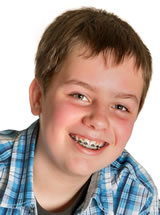
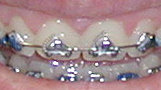
Braces are retainers, bonded brackets, arch wires and elastic bands that move crowded or spaced teeth into a "normal" position for appearance, prevention and function. Patients with poorly aligned teeth tend to have much more tooth decay, gum disease and jaw joint problems. Recently invented brackets and new techniques make orthodontic treatment faster and more comfortable than ever.
 |
 |
|
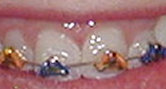
colored bands add a creative touch
to braces!
|
|
How do Braces work?
Over a period of time, teeth will shift if constant, gentle pressure is applied. Brackets are bonded to the front surface of each tooth and wires are attached to the brackets with elastic bands. The slight tension on the wire is gently transferred to the bracket through the elastic band.
 |
 |
|
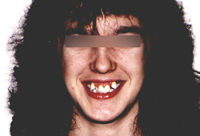
Before
|
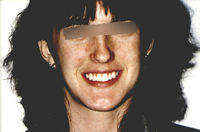
After
|
 |
 |
What are Retainers?
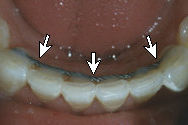
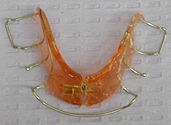
Once the teeth have been moved into proper position, a retainer is sometimes used to keep the teeth in place until they have "settled". Retainers can be fixed (bonded to the teeth) or removable.
 |
 |
|
Fixed retainer:
Small, thin wire bonded to tongue side of teeth |
Adjustable retainer:
Snaps into place. Easily adjusted. |
The Latest Trend in Orthodontics is No Braces at All!
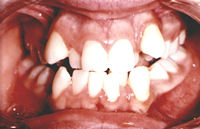
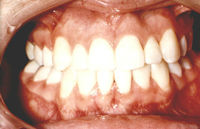
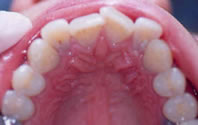
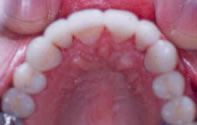
In many cases, where orthodontic treatment was once the only choice, patients can now choose "instant orthodontics" instead. Porcelain veneers are an excellent alternative to braces for many adults. Veneers can not only align teeth, but also modify undesirable contours and lighten the tooth color. In those cases where "instant orthodontics" is applicable, correction can be made in as little as two weeks.
 |
 |
|
Before
|
After
|
Please Contact Us if you would like more information.